
Nanomaterials for Water Purification in Cities and Industry
Urban water systems and industrial production generate enormous volumes of wastewater that contain heavy metals, pharmaceuticals, microplastics and persistent chemical compounds. Conventional filtration and chemical treatment methods remain important, yet many of them struggle with trace contaminants or require high energy consumption. By 2026, nanomaterials have become one of the most actively studied and implemented technologies for improving water purification efficiency. Their extremely small particle size and large surface area allow them to capture pollutants that traditional filters often miss, making them valuable for municipal infrastructure as well as industrial water recycling.
Why nanomaterials are effective in modern water treatment
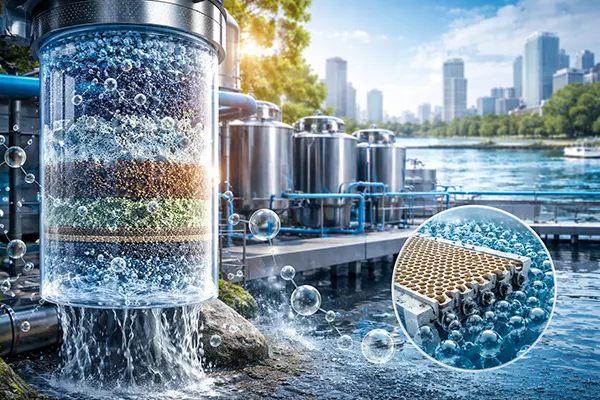
Nanomaterials operate at a scale of billionths of a metre, which significantly increases the active surface available for chemical reactions and adsorption. In water treatment systems this property enables nanoparticles to bind pollutants such as arsenic, lead, mercury or organic solvents much more efficiently than conventional filter media. Because of this large surface area, only a relatively small amount of material is required to treat large volumes of water.
Another advantage lies in the ability to engineer nanomaterials with specific properties. Scientists can modify surface chemistry so that particles selectively capture certain contaminants. For example, functionalised graphene oxide sheets are designed to attract heavy metals, while titanium dioxide nanoparticles can break down organic pollutants when exposed to ultraviolet light.
In 2026 many treatment systems combine nanomaterials with existing technologies such as membrane filtration, activated carbon filters and biological purification. This hybrid approach improves reliability while maintaining compatibility with current infrastructure used in municipal water plants and industrial facilities.
Main categories of nanomaterials used in purification systems
Metal oxide nanoparticles are among the most widely applied materials in water treatment research and pilot installations. Iron oxide nanoparticles are capable of removing arsenic and chromium from contaminated groundwater. Titanium dioxide nanoparticles are used for photocatalytic purification, breaking down organic pollutants such as dyes, pesticides and pharmaceutical residues.
Carbon-based nanomaterials also play a major role. Graphene oxide, carbon nanotubes and nano-structured activated carbon provide extremely high adsorption capacity. These materials can trap microplastics, oil residues and industrial solvents that often remain after traditional treatment processes.
Another promising category includes nano-engineered membranes. These membranes incorporate nanoparticles directly into filtration layers, increasing permeability while maintaining extremely small pore sizes. As a result, such membranes can remove viruses, bacteria and dissolved contaminants simultaneously while using less energy than conventional reverse-osmosis systems.
Applications in urban water infrastructure
Urban water utilities face increasing pressure to provide safe drinking water while dealing with ageing infrastructure and rising contamination levels. Nanomaterial-based filters are increasingly tested in municipal treatment plants to improve removal of emerging contaminants such as pharmaceutical residues, PFAS compounds and endocrine disruptors.
One practical application involves nano-enhanced membranes used in advanced filtration units. These membranes can operate with higher water flow rates and lower pressure, reducing energy consumption in desalination plants and large-scale purification facilities. Several pilot projects in Europe and Asia have already demonstrated improved efficiency in removing trace pollutants.
Another area of development is point-of-use purification systems. Household filtration cartridges containing nano-adsorbents can remove heavy metals and pathogens in regions where municipal treatment remains insufficient. Such systems are increasingly used in developing urban areas and emergency water supply programmes.
Role in removing emerging contaminants
Traditional water treatment technologies were designed primarily to remove suspended solids and pathogens. However, modern urban wastewater often contains complex chemical mixtures including pharmaceuticals, personal care products and industrial micro-pollutants. Nanomaterials provide additional mechanisms to capture or degrade these substances.
Photocatalytic nanomaterials are particularly useful in this context. Titanium dioxide nanoparticles, when exposed to ultraviolet or solar radiation, generate reactive oxygen species capable of breaking down organic contaminants into simpler, less harmful compounds. This process has shown promising results in pilot wastewater treatment plants.
Nanostructured adsorbents also demonstrate strong performance in removing PFAS chemicals, which are widely known for their persistence in the environment. Research projects in 2024–2026 have focused on hybrid graphene-based materials that capture PFAS molecules more efficiently than conventional activated carbon filters.
Industrial wastewater treatment and water reuse
Industrial processes in sectors such as mining, electronics manufacturing, textile production and chemical processing generate wastewater containing metals, solvents and complex organic compounds. Discharging these substances without advanced treatment can damage ecosystems and violate environmental regulations.
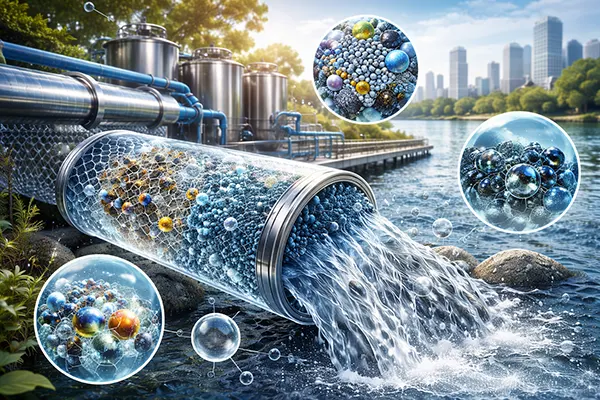
Nanomaterial-based technologies are increasingly integrated into industrial treatment systems because they allow targeted removal of specific pollutants. For example, magnetic nanoparticles coated with functional polymers can capture heavy metals from wastewater and then be separated using magnetic fields. This approach simplifies pollutant recovery and allows valuable metals to be recycled.
Another important benefit is water reuse. Many industries aim to reduce freshwater consumption by treating and recycling process water. Nanofiltration membranes and nano-adsorbents can purify wastewater to a quality suitable for reuse in cooling systems, washing processes or even certain production stages.
Environmental safety and technological challenges
Despite the advantages, the use of nanomaterials in water purification raises questions about environmental safety. Researchers study how nanoparticles behave after long-term use, particularly whether they might accumulate in ecosystems or enter drinking water systems. As a result, modern purification designs increasingly include recovery and containment mechanisms.
Another challenge concerns large-scale production and cost. Although laboratory results are promising, manufacturing nanomaterials in industrial quantities while maintaining consistent quality remains technically demanding. Over the past few years, progress in chemical synthesis and nanomaterial stabilisation has significantly reduced costs, making commercial adoption more realistic.
Regulatory frameworks are also evolving. Environmental agencies in the European Union, the United States and several Asian countries have introduced guidelines for testing nanomaterial safety in water treatment applications. These standards ensure that the technology improves water quality without introducing new environmental risks.