
Space-Based Solar Power: Beaming Energy to Earth with Microwaves
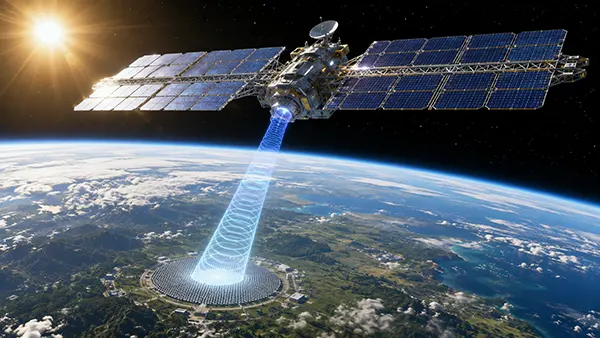
Space-based solar power has moved beyond being a purely theoretical energy concept, although it is still far from supplying ordinary electricity grids on a commercial scale. The idea is straightforward: large solar arrays collect sunlight in orbit, convert it into electricity and then transmit part of that energy towards Earth as a controlled microwave beam. A receiving station on the ground converts the microwave energy back into usable electricity and feeds it into the local grid. By 2026, researchers have demonstrated several important pieces of this process, including microwave power transfer in space and the detection of a power beam sent from orbit towards Earth. What has not yet been demonstrated is the complete process at anything close to the hundreds of megawatts or gigawatts required for a commercial power station. The remaining challenge is therefore not proving that microwave power transmission is physically possible, but making the entire system efficient, reliable, safe and affordable at an enormous scale.
How a Space-Based Solar Power Station Would Work
The main attraction of collecting solar energy in space is the availability of sunlight. A solar array operating in a suitable orbit is not affected by clouds, rain or the normal day-night cycle experienced by ground-based solar farms. Solar radiation is also stronger before it passes through Earth’s atmosphere. JAXA notes that solar irradiance available to a space solar power system can be roughly 40% stronger than at ground level. A spacecraft in geostationary orbit, around 36,000 kilometres above the equator, could remain in almost continuous sunlight for much of the year while maintaining a fixed apparent position relative to the Earth. Short eclipse periods would still occur around the equinoxes, so descriptions of completely uninterrupted sunlight should be treated as an approximation rather than a literal guarantee.
After sunlight reaches the orbital solar cells, the energy would pass through several conversion stages. Photovoltaic cells would first produce direct-current electricity. Electronic equipment would then convert some of this electrical power into radio-frequency energy, which would be sent through a large transmitting antenna. Instead of using a single conventional dish, many proposed designs rely on phased arrays consisting of large numbers of smaller antenna elements. By adjusting the timing, or phase, of the signal produced by each element, the combined radio waves can be concentrated towards a selected receiving area on Earth. This approach allows the beam to be electronically redirected without turning an enormous antenna mechanically.
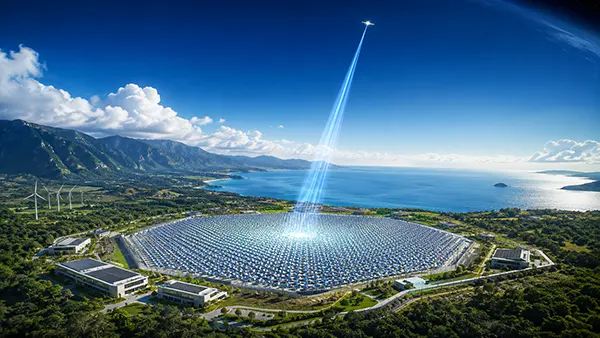
On the ground, the energy would arrive at a receiving antenna commonly known as a rectenna. A rectenna combines an antenna with rectifying electronics that convert radio-frequency energy back into direct-current electricity. An inverter could then change the output into alternating current suitable for the electricity grid. A commercial rectenna would probably cover a substantial area because microwave beams naturally spread over long transmission distances. Depending on the final design, parts of the land beneath a receiving array might still be usable because rectennas can be built from relatively open arrangements of antenna elements rather than solid roofs. However, the exact land requirements, access restrictions and environmental arrangements would depend on beam intensity, receiver design and national safety rules.
Why Microwaves Are Favoured for Long-Distance Power Beaming
Microwaves are attractive because selected radio frequencies travel through the atmosphere with relatively limited attenuation and can continue operating through cloud cover. JAXA has concentrated much of its research on microwave transmission below 10 GHz and has carried out major tests in the 5.8 GHz band. A British wireless-power project announced in 2026 also described work at 5.8 GHz, while a 2025 Caltech system study examined a different architecture operating at 10 GHz. There is therefore no single frequency that every future solar power satellite must use. Engineers have to balance atmospheric losses, antenna size, conversion efficiency, available radio spectrum and the possibility of interference with communications or other services.
A phased-array transmitter is central to most microwave concepts because it provides fine control over the direction of the beam. Individual antenna elements emit waves that reinforce one another in the intended direction and partly cancel one another elsewhere. The beam can therefore be moved electronically as orbital conditions change. Some designs use a pilot signal transmitted from the ground receiver towards the spacecraft. The orbital antenna detects this reference signal and adjusts its own transmission towards the source. JAXA calls this a retrodirective approach and has tested it as a way of compensating for changes in antenna alignment. Similar feedback concepts are also being considered as a safety measure because the transmitter can be designed to reduce or stop power if the authorised ground reference is lost.
Every conversion stage nevertheless costs energy. Electricity produced by the solar cells must be changed into microwave energy, transmitted across thousands of kilometres, collected by the rectenna and converted back into electricity. Even efficient components therefore produce an end-to-end efficiency considerably below 100%. JAXA’s 2015 ground demonstration illustrates the distinction between successful transmission and complete efficiency: approximately 1.8 kW of microwave power was transmitted across about 55 metres, while roughly 320 to 340 W was received under the stated test configuration. That experiment was designed primarily to test accurate beam control rather than to reproduce a complete orbital power station, but it demonstrates why conversion and transmission losses remain central to the economics of the technology.
What Has Already Been Demonstrated by 2026
One of the most important practical milestones came from the California Institute of Technology’s Space Solar Power Project. Its Space Solar Power Demonstrator, SSPD-1, reached orbit in January 2023 carrying three experiments. MAPLE, the Microwave Array for Power-transfer Low-orbit Experiment, used lightweight flexible microwave transmitters controlled by custom electronic chips. In March 2023, MAPLE transmitted power wirelessly between components in space and used the received energy to illuminate LEDs. Later that year, researchers detected a weak microwave signal directed from the spacecraft towards a receiving installation at Caltech. The amount of power reaching Earth was tiny and was never intended to supply useful electricity, but the experiment demonstrated that lightweight orbital hardware could form and steer a microwave power beam.
Japan has pursued the subject for considerably longer. JAXA’s Space Solar Power Systems research includes microwave transmission, laser transmission, large orbital structures, space-qualified solar cells and debris prevention. Its microwave work has included kilowatt-class ground tests and development of highly accurate beam-pointing methods. JAXA has studied concepts for a future 1 GW system in geostationary orbit, while its current public research material describes practical deployment as a longer-term objective for the latter half of the 21st century and notes that development scenarios are being reassessed. This makes an important distinction between an engineering target and an announced commercial power station: the gigawatt designs are reference concepts used to determine what technologies would be required.
European and British programmes have added further evidence. ESA’s SOLARIS work has examined commercial-scale space-based solar power, radio-frequency transmission, orbital construction, environmental effects and possible demonstration missions. Its 2023-2025 research period was intended to provide evidence for decisions on whether a much larger European development effort should follow. In the UK, Space Solar demonstrated its HARRIER wireless-power equipment in 2024, including electronic beam steering through 360 degrees, and reported completion of the £1.7 million CASSiDi engineering project in 2025. In April 2026, the company also described work with National Grid Electricity Distribution on terrestrial long-distance radio-frequency power transmission. These projects show continuing development of the necessary hardware, but they should not be confused with a functioning orbital electricity service.
The Gap Between a Demonstration and a Power Station
Scale is the most obvious difference. An experimental device can prove that a flexible antenna works, that a solar cell survives radiation or that a microwave signal reaches a receiver. A commercial station would have to combine these functions across structures potentially measuring hundreds of metres or kilometres. Such equipment cannot simply be launched as one rigid satellite. Components would need to fold for launch, deploy automatically or be assembled in orbit, remain accurately aligned and continue operating after years of exposure to radiation and repeated heating and cooling. Repairs would also be difficult because replacing a failed component thousands of kilometres above Earth is fundamentally different from servicing a terrestrial solar farm.
Beam accuracy becomes progressively more demanding as distance increases. JAXA has estimated that a conceptual 1 GW system transmitting from geostationary orbit to a receiving area about two kilometres across would require extremely precise pointing. Small angular errors over 36,000 kilometres can shift the beam by hundreds of metres. Future systems would therefore need several layers of control: accurate knowledge of the spacecraft’s position and orientation, electronic correction within the phased array, feedback from the ground receiver and automatic responses when the beam is not correctly aligned. The system would also need to manage deformation of a very large lightweight antenna, because even small changes in its shape can alter how signals from individual elements combine.
Transporting the hardware into orbit is another major obstacle. A utility-scale station could require large amounts of solar-cell material, structural components, electronics, antennas, propulsion equipment and thermal-control hardware. Lower launch prices improve the calculations, but launch price alone does not solve the problem. High flight rates, reliable reusable vehicles, orbital transfer, robotic assembly and long-life maintenance would all have to work together. This is why advances developed for other areas of the space industry, including autonomous robotics, spacecraft servicing and in-orbit construction, are closely connected with the prospects for space solar power even when those technologies were not originally created for energy generation.
Benefits, Risks and the Realistic Outlook for Space Solar Power
If the engineering difficulties can be solved, space-based solar power could offer a type of renewable generation that behaves differently from ordinary wind and solar farms. It could produce energy for far more hours each year and direct power towards a chosen ground receiver rather than relying entirely on a physical transmission line running from the generating site. In an electricity system with large amounts of weather-dependent renewable generation, that could provide useful firm power during periods when wind output is low or terrestrial solar production has fallen after sunset. The strongest case is therefore not necessarily replacing conventional renewable energy, but complementing it with another source whose availability follows different conditions.
Cost remains much less certain than the underlying physics. NASA’s 2024 assessment examined two conceptual 2 GW systems assumed to operate in 2050 and found that, under its baseline assumptions, their lifecycle electricity costs could be around 12 to 80 times higher than terrestrial renewable alternatives. NASA also stressed that different improvements in launch and manufacturing could substantially change those figures. A Caltech study published in 2025 reached a more optimistic result for its own modular architecture, estimating that after a decade of technological development, maturation and large-scale production, electricity might be delivered for about 9.4 US cents per kilowatt-hour. These estimates are not directly contradictory because they use different spacecraft designs, assumptions, manufacturing methods and future launch costs. Together they show how sensitive the economic case remains to technologies that do not yet exist at commercial scale.
The environmental calculation is similarly broader than simply asking whether the electricity comes from sunlight. Manufacturing large amounts of spacecraft hardware consumes materials and energy, while repeated launches produce emissions in atmospheric layers where their effects are still being studied. NASA found that lifecycle greenhouse-gas emissions from future systems might become comparable with terrestrial alternatives, but specifically identified uncertainty surrounding the atmospheric consequences of launch emissions. Orbital debris, radio-frequency interference, the physical area required for ground receivers and disposal of satellites at the end of their working lives would also have to be considered. A credible energy project would therefore require lifecycle assessment covering manufacturing, launch, operation, maintenance and eventual removal rather than considering orbital generation in isolation.
What Would Have to Happen Before Electricity Reaches the Grid
The next meaningful steps are likely to be increasingly complete demonstrations rather than an immediate jump to a full-size power station. Researchers need to show efficient transmission over genuine orbital distances at higher power, maintain accurate beam control for long periods and prove that lightweight solar and antenna structures can operate reliably for years. Later tests would need to connect generation, conversion, transmission and ground reception into a single end-to-end system. Moving from watts or kilowatts towards megawatts would provide much stronger evidence about thermal management, electrical efficiency, interference, maintenance and real operating costs. Until such demonstrations take place, gigawatt-scale designs remain engineering proposals rather than established energy infrastructure.
Regulation will be just as important as hardware. High-power radio-frequency transmission must coexist with communications, navigation, astronomy, aviation and other users of the electromagnetic spectrum. Governments and international organisations would need to agree suitable frequencies, licensing arrangements, exposure limits and procedures for protecting areas around ground receivers. Operators would also need robust cybersecurity because a system that controls the direction of a large power beam cannot depend on unprotected command or pilot signals. Grid operators, meanwhile, would require predictable output, protection equipment and clear procedures for connecting orbital generation to national electricity networks in the same way that other large generating assets must satisfy grid requirements.
As of 2026, the evidence supports a balanced view. The basic process of collecting solar energy and transferring power wirelessly with microwaves is based on established physics, and experiments have already demonstrated several critical elements in realistic conditions. The unanswered questions concern scale, economics, durability, safety regulation and the industrial effort required to build and maintain extremely large structures in orbit. Research programmes in the United States, Japan and Europe, together with private engineering projects, are gradually addressing these issues. Space-based solar power could eventually become a useful source of firm low-carbon electricity, but its future depends on whether successful laboratory and orbital demonstrations can be converted into systems that deliver electricity at a cost and reliability acceptable to ordinary power grids.