
Next-Generation Geothermal Energy: How Horizontal Drilling Unlocks the Earth’s Heat
Geothermal energy is entering a new stage of development as horizontal drilling makes it possible to extract heat from underground formations that conventional power stations could not use economically. Instead of relying exclusively on naturally occurring reservoirs of hot water, engineers can now construct underground systems that collect heat directly from deep rock. Techniques originally developed for oil and gas production are helping geothermal projects reach greater depths, increase energy output and operate in more locations. By 2026, commercial developments in the United States and Europe have demonstrated the potential of this approach, although drilling costs and geological challenges remain important obstacles.
How Horizontal Drilling Changes Geothermal Energy Production
Traditional geothermal electricity generation depends heavily on local geology. Power stations need access to underground reservoirs containing sufficiently hot water or steam, together with natural pathways that allow these fluids to circulate. Such conditions are found in areas including Iceland, Kenya, Indonesia and parts of the western United States. Elsewhere, substantial quantities of underground heat may exist without the natural water circulation needed for conventional production. Horizontal drilling addresses this limitation by allowing engineers to access hot rock and create longer underground pathways for collecting thermal energy.
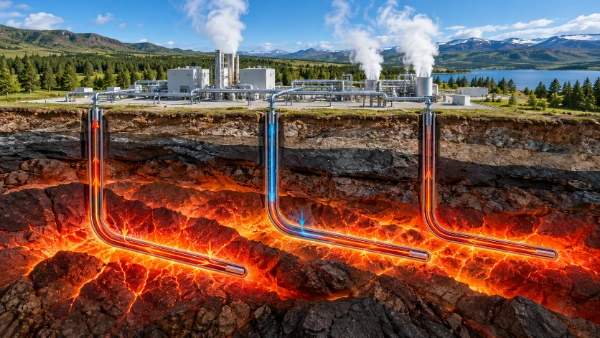
A geothermal well typically begins with a vertical section extending thousands of metres below the surface. Once the drill reaches the required depth, specialised equipment gradually changes its direction, producing a horizontal section through the heated formation. This allows the well to remain in contact with productive rock over a much greater distance than a conventional vertical borehole. Several horizontal sections can also be drilled from one surface location, reducing the number of separate drilling sites required. The precise depth and length depend on rock temperature, geological conditions and the system being developed.
The technology benefits from decades of drilling experience in the petroleum industry. Modern equipment can steer drill bits through complex underground formations, while sensors provide information about direction, temperature and drilling conditions. Engineers use geological surveys and measurements collected during drilling to determine suitable routes through the rock. The International Energy Agency identifies these advances as important factors in expanding geothermal development beyond established volcanic regions. However, horizontal drilling alone does not guarantee successful electricity generation: an effective system must also transfer sufficient heat to the surface at an economically useful rate.
Enhanced Geothermal Systems and Closed-Loop Technology
Enhanced geothermal systems, commonly known as EGS, use engineered underground pathways to circulate water through hot rock. Engineers drill injection and production wells, then improve connections between them by stimulating existing fractures in the formation. Water enters through the injection well, absorbs heat while moving through the rock and returns through the production well. At the surface, the recovered heat can generate electricity before the cooled water is reinjected. Horizontal wells make it possible to connect larger sections of rock and improve the arrangement of these underground circulation pathways.
Closed-loop geothermal systems take a different approach. Rather than circulating water directly through fractures in the surrounding rock, they use sealed underground pipes that transfer heat from the formation to a working fluid inside the system. The fluid remains separated from natural groundwater, and the installation does not require a permeable geothermal reservoir. Some designs incorporate multiple lateral boreholes to increase the contact area available for heat transfer. Their performance depends on factors including rock temperature, borehole length, flow rate and the ability of surrounding rock to replenish the extracted heat.
Both approaches extend geothermal possibilities, but their advantages are different. Enhanced geothermal systems can achieve substantial heat exchange by moving water through interconnected fractures, although they require careful reservoir management and seismic monitoring. Closed-loop installations avoid intentional circulation through surrounding rock, potentially reducing certain groundwater and induced-seismicity concerns. However, their heat output is limited by the rate at which heat can move through the rock towards the pipes. Neither technology is suitable everywhere, and commercial performance must be assessed through actual operating data rather than drilling depth alone.
Commercial Geothermal Projects Demonstrating the Technology in 2026
One of the most significant developments is Cape Station, an enhanced geothermal project operated by Fervo Energy in Beaver County, Utah. The company uses horizontal drilling and engineered underground circulation to generate electricity from deep hot rock. On 1 October 2026, Fervo announced that the first generating unit had reached commercial operation and achieved 33 megawatts of net electrical output. This marked an important step beyond small demonstration projects, showing that horizontal-well geothermal technology could support commercial electricity production under a power purchase agreement.
Cape Station’s first development phase consists of three generating units with a combined planned capacity of approximately 100 megawatts. The remaining two units were still undergoing commissioning in October 2026, with commercial operation targeted for early 2027. A further 400 megawatts is under construction, with operation expected in 2028. These are development targets rather than capacity already available to the electricity grid. Fervo has also demonstrated longer horizontal well designs, including sections measuring approximately 2.3 kilometres, as part of its efforts to improve the productivity and economics of future geothermal installations.
The importance of Cape Station extends beyond its generating capacity. It demonstrates how a geothermal developer can combine several underground wells, surface equipment and electricity connections into a repeatable commercial design. Multiple wells can be drilled from shared locations, while lessons from earlier drilling operations help improve subsequent construction. This approach is particularly relevant for electricity buyers seeking a dependable supply throughout the day and night. Unlike solar and wind generation, geothermal output does not depend directly on sunlight or wind conditions, although maintenance requirements and reservoir performance still influence actual availability.
Germany’s Geretsried Project and Its Closed-Loop Geothermal System
Germany provides another important example through Eavor’s geothermal development at Geretsried in Bavaria. The installation uses the company’s Eavor-Loop design, which connects deep boreholes into a sealed underground circulation system. Rather than extracting naturally occurring geothermal water, the installation gathers heat through contact between the boreholes and surrounding rock. The project began supplying electricity to the German grid in December 2025, demonstrating the practical operation of a commercial-scale closed-loop design. Its underground construction involves exceptionally long and accurately positioned boreholes, making drilling precision central to the system’s operation.
The complete Geretsried development has been designed for approximately 8.2 megawatts of electrical capacity and 64 megawatts of thermal output. These figures describe the intended full installation, not its verified operating output in October 2026. During the initial development phase, engineers demonstrated that deep lateral boreholes could be connected successfully and used to extract underground heat. The system also illustrates how geothermal energy can serve two markets: electricity generation and district heating. Supplying hot water to buildings can make practical use of thermal energy that would otherwise be difficult to convert efficiently into electricity.
Geretsried has also exposed the difficulties of developing unfamiliar geothermal technology. Although electricity production began successfully, the project had not achieved all its planned operational targets by October 2026. The developer decided to withdraw drilling rigs from the site while reassessing the costs and organisation of further work. This distinction matters because technical feasibility does not automatically establish commercial profitability. The experience demonstrates that sealed geothermal circuits can operate at significant depths, while also showing why construction schedules, drilling expenditure and sustained heat production must be evaluated before larger developments proceed.
Economic Potential and the Future of Deep Geothermal Energy
The economic attraction of next-generation geothermal energy comes from its ability to provide continuous low-carbon heat and electricity without requiring daily fuel deliveries. Once a wellfield and power station are constructed, underground heat can support generation for many years, provided that extraction rates are managed appropriately. The International Energy Agency’s 2024 assessment estimated that geothermal technologies could meet up to 15% of global electricity demand growth by 2050 under favourable conditions. This represents a potential development pathway, not a prediction that such deployment will necessarily occur.
Drilling remains one of the largest expenses because each underground well requires specialised equipment, skilled personnel and detailed geological planning. Hard formations can damage drill bits, while high temperatures place considerable demands on downhole instruments. Unexpected rock conditions may require changes to the drilling route, increasing costs and delaying construction. Developers must also finance geological surveys, circulation tests, surface power equipment and electricity connections before receiving revenue. Consequently, a geothermal resource can be technically accessible yet financially unattractive if the temperature, expected output or local energy prices are insufficient.
Horizontal drilling can improve project economics by increasing the amount of heated rock reached from a single surface site. Longer wells may produce more useful heat, while shared drilling locations reduce certain construction and land requirements. Repeated projects can also benefit from improved drilling procedures, more reliable equipment and experience gained by contractors. However, longer boreholes are not automatically cheaper or more productive. Developers must compare the additional drilling cost with the extra energy they expect to recover over the project’s lifetime, including the possibility that underground temperatures near the wells will gradually decline.
Environmental Challenges and the Prospects for Wider Adoption
Geothermal power generally has a relatively small surface footprint compared with many other forms of energy production, particularly when several wells share one drilling site. It also avoids the direct combustion emissions associated with coal and natural gas power stations. Environmental impacts nevertheless vary between technologies and locations. Construction creates emissions, drilling requires materials and energy, and some geothermal developments use significant quantities of water. Projects must also account for groundwater protection, equipment noise, the management of underground fluids and the appropriate restoration of temporary construction areas.
Induced seismicity deserves particular attention in enhanced geothermal systems because changing underground fluid pressure can activate existing geological fractures. Operators manage this risk through geological assessment, controlled injection procedures and continuous seismic monitoring. At Cape Station, Fervo reported 36 seismic events in its yellow monitoring category, with magnitudes between 2 and 3, during the period from November 2025 to April 2026. The largest recorded event in that reporting period had a local magnitude of 2.87. Closed-loop systems avoid the same direct stimulation process, although their construction and operation still require geological and environmental assessment.
By 2026, horizontal drilling has moved next-generation geothermal energy from experimental concepts towards commercial electricity production, but large-scale expansion will depend on reducing drilling costs and proving reliable performance over time. Its strongest opportunities may emerge where underground temperatures are favourable, electricity demand is substantial and existing drilling expertise is available. District heating networks offer additional opportunities where electricity generation alone would be less efficient. Geothermal energy is unlikely to replace every other renewable source, yet its ability to provide steady output could make it an increasingly valuable part of electricity and heating systems as more projects establish a dependable commercial track record.