
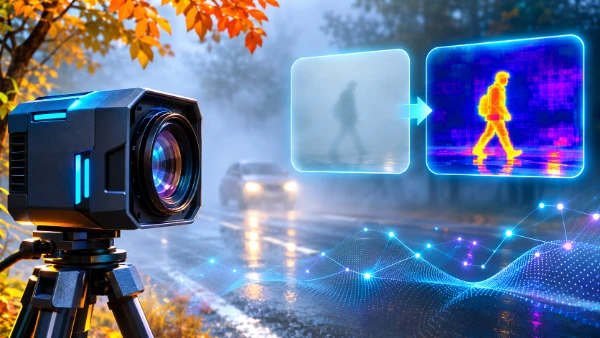
Neuromorphic Cameras Against Dense Fog: How Brown University’s Research Reveals Objects Hidden from Conventional Cameras
Dense fog remains a serious obstacle for autonomous vehicles, rescue drones, underwater robots and other systems that depend on optical sensors. In 2026, researchers at Brown University presented an imaging technique that addresses this problem by taking inspiration from the human visual system. Instead of relying on conventional photographs or video frames, the technology combines a neuromorphic camera with a spiking neural network to reconstruct the shapes of obscured moving objects and track their positions. Laboratory experiments demonstrated that the system could recover recognisable silhouettes under conditions in which ordinary cameras produced practically unusable images. Although the technology remains experimental, it offers a different approach to machine vision in environments where light scattering severely restricts visibility.
Why Neuromorphic Cameras Can Detect Objects Through Dense Fog
Conventional cameras depend on receiving sufficient light from an object to produce a recognisable image. Fog interferes with this process because suspended water droplets scatter light in different directions before it reaches the camera lens. As fog becomes denser, the distinction between an object and its surroundings gradually disappears. Increasing camera resolution does not necessarily solve the problem, since a higher number of pixels cannot compensate for the loss of meaningful visual information. Adjusting brightness or contrast may improve photographs taken in light mist, but these methods become considerably less effective when the original image contains almost no distinguishable outlines.
Neuromorphic cameras, also known as event-based cameras, approach visual information differently. Rather than recording complete images at fixed intervals, their individual pixels respond independently to changes in brightness. When something moves across the field of view, the resulting changes in light intensity generate a series of electronic signals. Areas where brightness remains relatively constant produce fewer signals. This allows the camera to concentrate on changes within a scene rather than repeatedly recording every visible detail. In an environment filled with fog, such selective sensing can help preserve information associated with movement that would otherwise be overwhelmed by scattered light.
Consider a cyclist travelling along a road covered in thick morning fog. A conventional camera might record a sequence of almost uniformly grey images, with only faint variations indicating the cyclist’s presence. An event-based sensor may capture some of the brightness changes created as the cyclist moves. These signals would not immediately resemble a recognisable person or bicycle, but they could contain useful information about movement and shape. The challenge is to separate meaningful signals from background interference and assemble them into an accurate representation. This is the particular problem that Brown University’s research seeks to address.
How the Human Visual System Inspired the Technology
The biological inspiration behind neuromorphic imaging comes from the way the retina and brain cooperate to interpret visual information. The human visual system is particularly sensitive to changes, including moving objects, shifting outlines and variations in illumination. It does not operate like a conventional digital camera that regularly saves complete photographs. Instead, information passes through interconnected biological structures that respond to different visual features. Engineers working on neuromorphic technologies attempt to reproduce selected aspects of this behaviour, creating artificial sensors and computational systems that process relevant changes rather than treating every part of an image equally.
Brown University’s experimental system combines a dynamic vision sensor with a spiking neural network. The sensor records changes in illumination, while the network examines the resulting signals over time. An isolated signal may provide very little information about an obscured object, but a sequence of related signals can reveal a more consistent pattern. The software uses these accumulated observations to estimate the object’s location and reconstruct its silhouette. This process is particularly important when the available visual information is fragmented, as happens when light travels through suspended particles or water droplets.
The approach also changes the way computational resources are used. A conventional video analysis system must regularly process complete images, including areas that have remained unchanged since the previous frame. Event-based sensing can reduce this repetitive workload by generating data primarily when something happens. For battery-powered equipment, such as compact drones or mobile robots, processing fewer unnecessary observations could become a practical advantage. However, the efficiency of the complete imaging system would still depend on its hardware, software, operating conditions and the amount of movement within the surrounding environment.
What Brown University’s 2026 Experiments Demonstrated
The research was conducted by Ning Zhang and Arto Nurmikko from Brown University’s School of Engineering. Their study, titled Neuromorphic Optical Tracking and Imaging of Randomly Moving Targets Through Dynamic Dense Scattering Media, was first published in Advanced Science on 24 August 2026 and appeared in the journal’s November issue. Brown University subsequently presented the development in an official announcement dated 1 October 2026. The research addressed two closely connected problems: reconstructing the appearance of obscured moving targets and determining their changing positions without relying on clear conventional images.
The researchers conducted controlled experiments involving artificial light-scattering materials, cloudy water and moving fog. Their test subjects included numerical digits, Japanese Kanji characters and two-dimensional bird silhouettes following irregular trajectories. These designs provided a useful range of visual complexity, allowing the researchers to examine whether the system could recover recognisable shapes rather than simply indicate the presence of movement. Using known targets also made it possible to compare reconstructed images with the original designs and evaluate the quality of the results under different experimental conditions.
Testing irregular movement was especially important. A system that follows a predictable object along a predetermined route may perform well without being suitable for more complicated situations. In everyday environments, people change direction, animals move unpredictably and vehicles alter their speed. The Brown University experiments investigated whether visual reconstruction could remain effective when the target’s movement was not straightforward. Nevertheless, the tests used controlled two-dimensional targets, so the findings should not be interpreted as evidence that the system can already identify every type of three-dimensional object encountered on a road or during a rescue operation.
Understanding the Reported Image Reconstruction Accuracy
One of the most notable results was a structural similarity index reaching 0.96. This measurement indicates how closely a reconstructed image resembles a reference image in terms of its visual structure. Expressed as a percentage, the best reported score corresponds to 96% structural similarity. It does not mean that the technology correctly identifies 96% of pedestrians, vehicles or other objects in real-world fog. The distinction matters because image reconstruction and object recognition are separate tasks. A recognisable silhouette can provide valuable information without necessarily establishing the precise identity of the object that produced it.
The published study also reported that processing an entire input sequence could take less than 15 milliseconds under the experimental computing conditions. Its energy analysis indicated a potential eighteenfold reduction compared with an equivalent conventional artificial neural network. These figures are encouraging for applications requiring rapid visual interpretation and limited electricity consumption. However, the processing measurement does not represent the complete reaction time of an autonomous vehicle, while the energy comparison concerns the neural network rather than the total consumption of a finished camera, computer and control system.
The results are therefore most useful as evidence that visual information can sometimes be recovered even when an ordinary camera cannot produce a meaningful picture. They suggest that changing the method of collecting and interpreting light may be more effective than attempting to improve an already degraded photograph. Before the technology can support safety-critical decisions, researchers will need to determine how consistently it performs across different distances, fog densities, lighting conditions and unfamiliar objects. Establishing these operating limits will be just as important as improving the highest image similarity scores achieved in controlled experiments.
Potential Applications in Autonomous Transport, Rescue Operations and Medicine
Autonomous vehicles are among the most relevant potential beneficiaries of neuromorphic imaging. Driving through fog requires more than detecting the presence of an obstacle. A vehicle must also determine whether the obstacle is moving, where it is located and whether its trajectory creates a collision risk. Additional visual information could help an automated driving system interpret a situation that remains difficult to assess using ordinary cameras. Independent research published in Nature in 2024, examining event-based automotive vision, had already demonstrated the relevance of this sensing method to reducing delays in visual processing. The Brown University study extends the discussion to severely degraded optical visibility.
Emergency services could also benefit from improved imaging in difficult atmospheric conditions. Rescue drones operating around coastal areas, mountains or flooded regions frequently encounter poor visibility that restricts their usefulness. A lightweight sensor capable of extracting information about movement from an otherwise unclear scene could provide another source of observations for rescue personnel. Similar technology might eventually assist firefighters working in smoke-filled environments. However, smoke and fog have different optical properties, and successful laboratory experiments involving fog cannot automatically establish that the same equipment will operate reliably during a fire.
Underwater exploration and medical imaging represent two further areas of interest. Underwater robots regularly encounter suspended sediment that limits the usefulness of optical cameras, particularly near the seabed or in disturbed water. Recovering visual information from moving targets could assist inspection and navigation. Biological tissues also scatter light, creating difficulties for some medical imaging techniques. Neuromorphic sensing may eventually contribute to methods for observing dynamic biological structures. These possibilities remain research directions rather than confirmed commercial or clinical applications, and each would require testing appropriate to its specific operating environment.
Current Limitations and the Future of Neuromorphic Imaging
The most significant limitation of Brown University’s technique is its dependence on relative movement. An object that remains stationary in relation to the sensor and produces no sufficient change in illumination may generate too little information for successful reconstruction. This presents an important challenge for applications such as autonomous driving, where stationary obstacles can be as dangerous as moving ones. The experimental system also reconstructs outlines rather than detailed photographs containing complete tonal and surface information. Consequently, recognising a shape does not necessarily provide enough evidence to determine an object’s exact nature, physical condition or distance from the observer.
Low-light performance presents another difficulty. Neuromorphic cameras still depend on receiving light, and their ability to register meaningful changes decreases when illumination becomes insufficient. According to Brown University’s October 2026 research announcement, the team is investigating methods of amplifying weak optical signals and extending the technique to capture information about three-dimensional targets. Possible approaches include combining observations from two event cameras or using measurements associated with the travel time of light. Such developments could help address the need for depth information, which is particularly important for robotic navigation and obstacle avoidance.
As of November 2026, Brown University’s development is best understood as a promising experimental addition to existing machine vision technologies rather than a complete replacement for conventional cameras, radar, lidar or thermal imaging. Its practical value may ultimately lie in combining complementary sensors, each contributing information under conditions where another becomes less reliable. A commercially useful system would need to demonstrate dependable performance outside the laboratory, manageable manufacturing costs and compatibility with existing equipment. The research nevertheless establishes an important principle: when fog makes an ordinary image unusable, analysing changes in light over time can reveal visual structures that conventional photography fails to preserve.