
Optical Chips: Why Photonic Processors Could Become the Next Step After Silicon
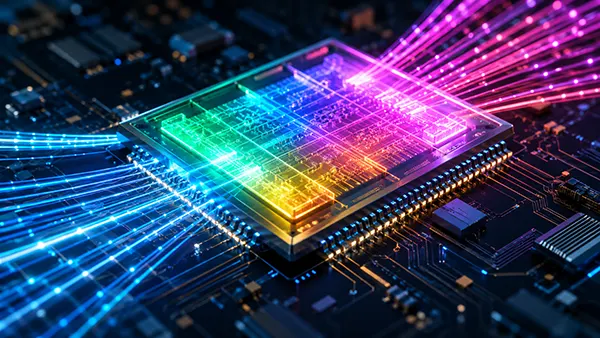
For more than half a century, silicon has been the foundation of modern computing. From personal computers to artificial intelligence systems and cloud data centres, silicon transistors have enabled remarkable technological progress. However, as chip manufacturers approach physical and economic limitations in transistor scaling, researchers and technology companies are investigating alternative approaches. One of the most promising developments is photonic computing, where information is processed and transmitted using light instead of electrical signals. Optical chips and photonic processors could help overcome several challenges facing conventional semiconductor technologies and may play an important role in the future of high-performance computing.
The Growing Limitations of Silicon-Based Computing
Silicon chips have become increasingly powerful through decades of miniaturisation. The semiconductor industry has benefited from shrinking transistor sizes, allowing more processing power to be packed into smaller areas. However, modern manufacturing processes are reaching scales measured in only a few nanometres, making further reductions technically difficult and increasingly expensive.
Another challenge is energy consumption. Modern processors generate substantial heat when billions of transistors switch on and off every second. Data centres supporting cloud services and artificial intelligence workloads consume significant amounts of electricity, creating concerns about operational costs and environmental impact. Improving performance while reducing energy requirements has become a major objective for hardware developers.
Data transfer is also becoming a bottleneck. Even when processors can perform calculations quickly, moving information between memory, storage systems and computing units often limits overall performance. Electrical signals travelling through traditional circuits encounter resistance, signal degradation and heat generation, which can reduce efficiency as computing systems continue to grow in complexity.
Why Traditional Scaling Is Becoming More Difficult
The semiconductor industry has historically relied on Moore’s Law, the observation that transistor density on integrated circuits roughly doubles over time. Although innovation continues, maintaining this pace has become increasingly challenging due to manufacturing complexity and rising production costs.
Advanced fabrication facilities require investments measured in tens of billions of pounds. Only a small number of companies possess the resources and expertise necessary to produce the most advanced chips. This concentration creates economic and supply-chain challenges for industries that depend on cutting-edge semiconductors.
Engineers are therefore exploring complementary technologies rather than relying exclusively on smaller transistors. Photonic computing represents one of the most significant alternatives because it addresses several limitations associated with electrical signal transmission while offering opportunities for substantial performance improvements.
How Photonic Processors Use Light for Computation
Unlike conventional chips that use electrons moving through conductive materials, photonic processors use photons to carry and process information. Because photons travel at the speed of light and do not experience electrical resistance in the same way as electrons, optical systems can potentially achieve faster communication with lower energy consumption.
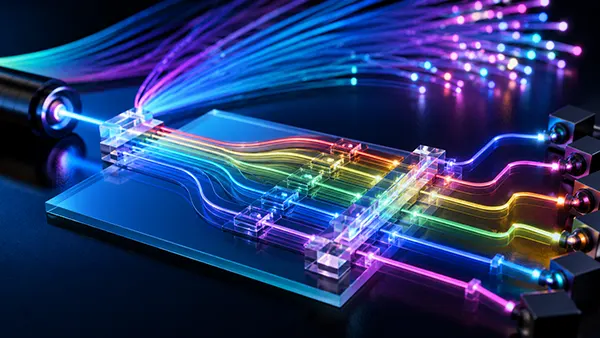
Photonic circuits contain components such as waveguides, optical modulators, lasers and photodetectors. These elements guide and manipulate light signals in a manner similar to how transistors control electrical current. Information can be encoded into different properties of light, including wavelength, phase and intensity.
One of the most attractive characteristics of photonic computing is parallelism. Multiple wavelengths of light can travel through a single optical channel simultaneously without interfering with one another. This capability allows large amounts of data to be processed or transmitted at the same time, creating opportunities for significant performance gains in specialised computing tasks.
Current Applications of Photonic Technology
Optical technologies are already widely used in telecommunications. Fibre-optic networks transmit internet traffic across continents using light signals because they offer higher bandwidth and lower signal loss than traditional copper connections. Researchers are now adapting similar principles for on-chip communication and computation.
Artificial intelligence is one of the most promising application areas. Many machine learning workloads depend heavily on matrix multiplication and parallel data processing. Photonic processors can perform certain mathematical operations efficiently using optical interference, potentially reducing energy consumption while maintaining high computational throughput.
Several organisations, including Lightmatter, Lightelligence, Intel, IBM and research institutions across Europe, North America and Asia, are actively developing photonic hardware. By 2026, experimental photonic accelerators and optical interconnect technologies are already being tested for AI training, scientific computing and advanced networking applications.
The Future Potential of Optical Computing
Although photonic processors offer substantial advantages, they are unlikely to replace silicon entirely in the near future. Many computing tasks still benefit from traditional electronic logic, and current photonic systems often require hybrid architectures that combine optical and electronic components on the same device.
Manufacturing challenges remain significant. Producing photonic circuits at large scale requires precise fabrication techniques and specialised materials. Engineers must also solve issues related to integration, software compatibility and system design before photonic computing can become mainstream.
Despite these challenges, industry investment continues to increase. The rapid growth of artificial intelligence, cloud computing and high-performance computing is creating demand for technologies capable of delivering higher efficiency and greater data-processing capacity than conventional architectures can provide.
What the Next Decade Could Look Like
During the coming decade, optical technologies are expected to appear first in specialised environments where performance and energy efficiency are critical. Data centres, AI accelerators and supercomputers are likely to become early adopters because they can benefit most from high-bandwidth optical communication and processing.
Hybrid chips combining electronic and photonic components may become increasingly common. Rather than replacing silicon, optical technologies could complement existing architectures by handling communication-intensive and data-intensive workloads more efficiently than electrical circuits alone.
If current research and commercial development continue successfully, photonic processors could become one of the most important advances in computing since the rise of modern semiconductor technology. Their ability to process information using light offers a realistic path towards overcoming some of the most significant limitations facing silicon-based systems in 2026 and beyond.