
Humanoid Robots in Warehouses: Real Tasks They Can Perform in 2026
By 2026, humanoid robots have moved beyond experimental prototypes and are gradually entering real warehouse environments. Their role is no longer theoretical: major logistics companies and manufacturers are already testing and deploying them in controlled scenarios. While they are not replacing entire workforces, their capabilities are becoming increasingly practical, especially in repetitive, physically demanding, or precision-based tasks.
Where Humanoid Robots Fit into Modern Warehouse Operations
Warehouse automation has traditionally relied on conveyor belts, robotic arms, and autonomous mobile robots (AMRs). However, these systems are usually designed for specific tasks. Humanoid robots introduce a different concept: machines capable of operating in spaces built for humans, using similar tools and workflows without requiring full infrastructure redesign.
In 2026, companies such as Tesla (Optimus), Figure AI, and Agility Robotics are focusing on humanoid systems that can walk, grasp objects, and interact with shelving units. This flexibility allows them to integrate into existing warehouses where retrofitting would otherwise be expensive or disruptive.
Rather than acting as replacements for specialised machines, humanoid robots complement them. They are particularly useful in environments where variability is high — for example, warehouses dealing with mixed product sizes, irregular packaging, or constantly changing layouts.
Adaptability to Human-Centred Environments
One of the key advantages of humanoid robots is their ability to function in spaces designed for people. This includes climbing stairs, opening standard doors, and navigating narrow aisles without requiring new infrastructure.
In practice, this means companies can deploy them in older facilities where traditional automation would require costly redesigns. A humanoid robot can use the same ladders, carts, and storage systems as human workers, which significantly lowers the barrier to adoption.
However, adaptability is still evolving. In 2026, robots perform best in semi-structured environments where variables are limited, and processes are clearly defined. Fully chaotic or highly dynamic environments remain challenging.
Core Tasks Humanoid Robots Can Perform in 2026
The most realistic applications of humanoid robots today are focused on tasks that combine repetition with moderate complexity. These include picking items, transporting goods, and handling basic sorting operations.
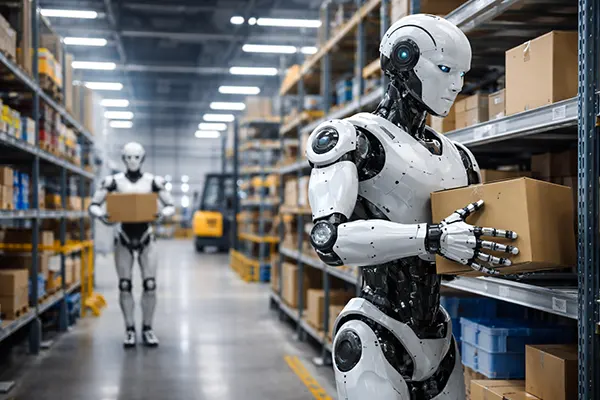
Item picking is one of the most important use cases. Modern humanoid robots equipped with vision systems and AI models can identify products, adjust grip strength, and place items into containers. While their speed is still lower than specialised picking systems, their flexibility makes them valuable in mixed-product environments.
Another key task is internal transport. Humanoid robots can carry boxes, load carts, or move items between zones. This reduces the physical strain on human workers and allows staff to focus on decision-making tasks rather than manual handling.
Handling and Sorting Mixed Inventory
Sorting remains a complex process in warehouses dealing with diverse product categories. Humanoid robots in 2026 can assist by identifying labels, scanning barcodes, and placing items into appropriate bins.
Unlike fixed sorting machines, humanoid robots can adjust to new sorting rules without physical reconfiguration. Updates can be deployed via software, allowing faster adaptation to changing logistics requirements.
Despite these capabilities, accuracy still depends heavily on training data and environmental conditions. Poor lighting, damaged packaging, or unclear labels can reduce performance, which is why human supervision remains necessary in most deployments.
Limitations and Operational Constraints
Although progress is significant, humanoid robots in 2026 still face clear limitations. Their speed, battery life, and reliability are not yet at the level required for full-scale replacement of human labour.
Battery constraints are a major factor. Most humanoid robots operate for a few hours before needing recharging, which limits continuous operation. Swappable battery systems are being developed but are not yet standard across all platforms.
Another limitation is cost. Early deployments are expensive, with units costing tens of thousands of pounds. This restricts adoption primarily to large logistics companies that can justify the investment through long-term efficiency gains.
Human–Robot Collaboration in Practice
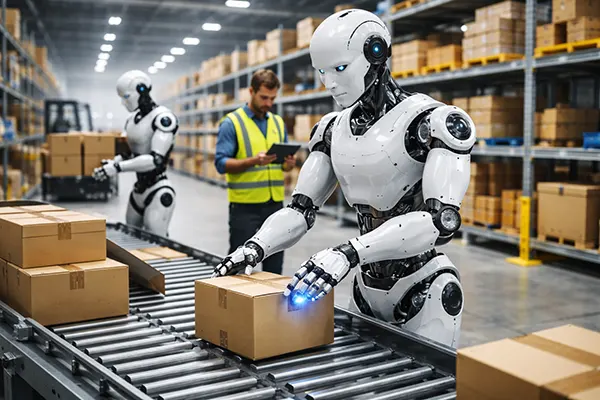
Instead of replacing workers, humanoid robots are increasingly used alongside them. In 2026, the most effective setups involve robots handling repetitive or physically demanding tasks while humans oversee operations and manage exceptions.
This collaborative model improves workplace safety by reducing injuries related to lifting and repetitive strain. It also allows human workers to shift towards roles that require judgement, coordination, and problem-solving.
However, successful collaboration depends on clear workflows and safety systems. Sensors, real-time monitoring, and emergency stop mechanisms are essential to ensure that humans and robots can work safely in the same space.