
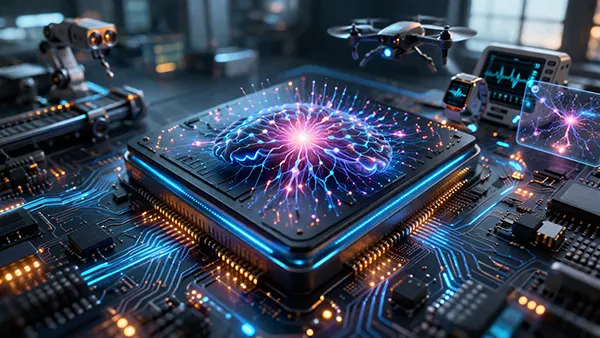
Neuromorphic Chips: How Brain-Inspired Computing Is Moving from Labs into Real Devices
Neuromorphic computing has shifted from a theoretical concept to a practical engineering direction that is already influencing real hardware in 2026. Inspired by how biological neurons process information, these chips aim to deliver efficient, low-power computing for tasks where traditional architectures struggle. As industries demand faster decision-making at the edge and reduced energy consumption, neuromorphic systems are gradually leaving research environments and entering commercial and industrial applications.
What Makes Neuromorphic Chips Different from Traditional Processors
Unlike classical CPUs and GPUs, which process data sequentially or in parallel using predefined instructions, neuromorphic chips are designed to mimic the structure and behaviour of neural networks in the brain. They rely on artificial neurons and synapses that communicate through spikes, enabling asynchronous and event-driven computation. This fundamentally changes how information is processed, especially in real-time environments.
One of the key advantages is energy efficiency. Traditional processors require continuous power to maintain operations, even when processing minimal data. Neuromorphic systems, however, activate only when events occur. This allows them to operate with dramatically lower power consumption, which is critical for mobile devices, IoT systems, and autonomous machines.
Another important distinction lies in adaptability. Neuromorphic chips can learn from incoming data streams without requiring constant retraining in large data centres. This local learning capability reduces latency and enhances privacy, as data can be processed directly on the device rather than being sent to external servers.
Core Technologies Behind Neuromorphic Architectures
Modern neuromorphic chips are built using spiking neural networks (SNNs), which differ significantly from traditional deep learning models. Instead of processing continuous values, SNNs operate on discrete spikes, closely resembling biological neuron behaviour. This allows for more efficient temporal data processing, such as recognising patterns in audio or sensor signals.
Another important component is the use of specialised memory structures, often integrated directly with processing units. This eliminates the bottleneck seen in conventional architectures, where memory and processing are separated. By combining both, neuromorphic chips reduce data transfer delays and improve performance efficiency.
Hardware examples such as Intel’s Loihi and IBM’s TrueNorth demonstrate how these concepts are implemented in practice. These chips are capable of handling complex pattern recognition tasks while consuming significantly less energy than traditional AI accelerators, making them suitable for edge computing scenarios.
Where Neuromorphic Chips Are Already Being Used
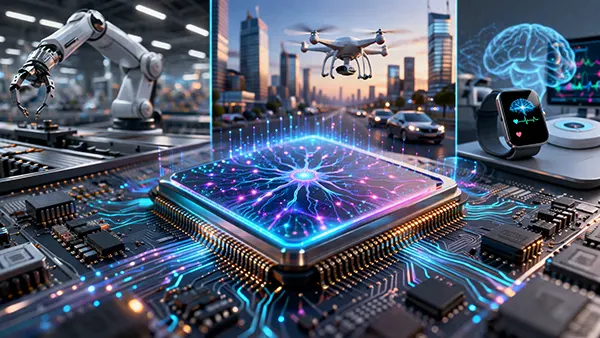
In 2026, neuromorphic computing is no longer confined to academic experiments. It is actively being tested and deployed in real-world environments where conventional computing faces limitations. One of the most prominent areas is robotics, where machines require fast and efficient processing of sensory input.
Autonomous systems, including drones and self-driving vehicles, benefit from neuromorphic chips due to their ability to process data in real time with minimal energy consumption. These systems must react instantly to environmental changes, and neuromorphic architectures provide the necessary speed without relying on cloud-based processing.
Healthcare is another sector where neuromorphic technology is gaining traction. Devices designed for brain–computer interfaces and wearable monitoring systems use these chips to analyse neural signals efficiently. This opens up possibilities for more responsive prosthetics and advanced neurological diagnostics.
Edge Computing and IoT Integration
The growth of edge computing has created a demand for hardware that can process data locally. Neuromorphic chips are well suited for this role because they can operate with limited power and without constant connectivity. This makes them ideal for smart sensors, industrial monitoring systems, and remote devices.
In industrial settings, neuromorphic processors are used to detect anomalies in machinery by analysing vibration, sound, or temperature patterns. Their event-driven nature allows them to identify issues early without processing unnecessary data, which improves efficiency and reduces maintenance costs.
Consumer electronics are also beginning to incorporate neuromorphic elements. From advanced voice recognition in portable devices to adaptive cameras that respond to changing environments, these chips enable smarter and more responsive user experiences without significantly increasing energy consumption.
Challenges Slowing Down Mass Adoption
Despite clear advantages, neuromorphic computing still faces several technical and practical challenges. One of the main issues is the lack of standardised development tools. Engineers are more familiar with traditional programming models, while neuromorphic systems require new approaches and frameworks that are still evolving.
Another limitation is scalability. While neuromorphic chips perform well in specialised tasks, integrating them into large-scale systems remains complex. Many existing infrastructures are built around conventional architectures, making it difficult to incorporate entirely new computing paradigms without significant redesign.
There is also a gap in software ecosystems. Training and deploying spiking neural networks is more complex compared to conventional AI models. Although progress is being made, developers still lack mature libraries and tools that would simplify adoption and accelerate innovation.
What the Next Few Years May Bring
Research and investment in neuromorphic computing continue to grow, particularly in Europe and the United States. Public and private initiatives are funding the development of more accessible hardware and software solutions, which could reduce current barriers to entry.
In the near future, hybrid systems are likely to emerge, combining traditional processors with neuromorphic accelerators. This approach allows developers to benefit from existing infrastructure while gradually integrating brain-inspired computing where it provides the most value.
As demand for energy-efficient AI increases, neuromorphic chips are expected to play a more significant role in areas such as smart cities, environmental monitoring, and personalised healthcare. Their ability to process information efficiently and adapt in real time positions them as a key component of next-generation computing systems.