
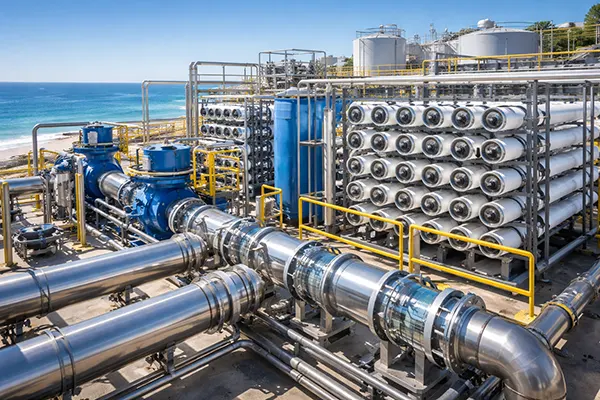
Desalination with Energy Recovery: Modern Reverse Osmosis Systems in 2026
Seawater reverse osmosis (SWRO) has become the default choice for new desalination capacity because it scales well and, crucially, it can reclaim a large share of the pressure energy that would otherwise be wasted in the brine stream. In 2026, the conversation is less about whether SWRO works and more about how close a plant can get to the practical energy floor while staying reliable under real seawater conditions: variable temperature, seasonal algae, and long intake pipelines.
Why energy recovery is the main lever in SWRO efficiency
In a conventional SWRO train, the high-pressure pump raises seawater to roughly the same pressure as the membranes require. After separation, the concentrate (brine) still carries most of that pressure. If you simply throttle it down across a valve, you throw away a large chunk of the plant’s electrical input as heat and noise. Energy-recovery devices (ERDs) exist to convert that “leftover” hydraulic power into useful work.
The theoretical minimum energy to desalinate 35 g/L seawater at 50% recovery is often cited at about 1.06 kWh per cubic metre of product water, and that figure is a useful reality check: it shows why you will never reach zero, and why chasing small fractional gains gets expensive. What matters in practice is how much of the gap between that limit and real-world operation comes from avoidable losses—pump efficiency, pressure losses, mixing, membrane permeability, pretreatment headloss, and control stability.
By 2026, the leading designs treat the ERD as a core piece of the process, not an add-on. Plant-wide energy performance is engineered around matching membrane array design, recovery ratio, high-pressure pump selection, and ERD operating window, so the system stays efficient not just at design point, but across daily salinity and temperature swings.
Pressure exchangers vs turbines: what plants actually choose
Two ERD families dominate SWRO discussions: turbine-based devices (such as Pelton turbines or turbochargers) and isobaric pressure exchangers. Turbines convert brine pressure into shaft power, which is then coupled back into the pump or a generator. They can work well, but their efficiency drops when the plant runs far from its design point, and they introduce more moving parts and control complexity.
Isobaric pressure exchangers transfer pressure directly from the brine to the incoming feed stream. The “direct transfer” approach reduces conversion losses and is one reason modern pressure exchangers advertise very high peak efficiencies (commonly quoted around 98% for current product lines). In practical terms, that means the high-pressure pump only needs to supply the net pressure difference and overcome friction losses, rather than continuously “recreating” the full membrane pressure from scratch.
Recent benchmarking results show why this matters. The DESALRO 2.0 project in Gran Canaria was recognised for exceptionally low specific energy consumption in SWRO, highlighting what is achievable when the ERD, pumps, and hydraulics are designed as one system rather than optimised in isolation.
System design choices that protect efficiency under real seawater conditions
Energy recovery is only as good as the hydraulic environment around it. A plant can own a high-efficiency ERD and still underperform if the intake, pretreatment, cartridge filtration, and high-pressure piping create unnecessary pressure losses. In 2026, strong design teams focus on total headloss budgets and operational stability: fewer abrupt throttling events, fewer rapid salinity swings at the membranes, and smoother ramping of pump speed.
High-pressure pump efficiency is another decisive factor. Modern SWRO projects increasingly specify pump curves and motor/drive packages that keep efficiency high across a wider operating range. Variable-speed drives are no longer a “nice to have” but a standard tool to match pressure to membrane needs as seawater temperature changes, which directly affects viscosity and net driving pressure.
Membrane selection and array layout also matter more than marketing claims about a single membrane’s permeability. Higher permeability can reduce required pressure, but only if it does not raise fouling risk or compromise salt rejection under the site’s pretreatment limits. Plants therefore evaluate membranes together with spacer design, flux targets, and clean-in-place strategy, because fouling events quickly erase any efficiency gain with extra pressure and downtime.
Advanced RO configurations: CCRO, batch logic, and tighter controls
Beyond standard single-stage designs, semi-batch approaches such as closed-circuit reverse osmosis (CCRO) continue to attract attention because they can, in theory, reduce some irreversible losses and improve energy efficiency. Research and pilot studies published recently have focused on where CCRO gains are real and where practical inefficiencies (valves, cycling losses, control limits) reduce the theoretical advantage.
The most credible 2026 implementations treat these configurations as tools for specific problems rather than universal replacements. For example, CCRO-style operation can be attractive in certain brackish or reuse applications where recovery is constrained by scaling and where smarter cycling can reduce chemical demand. For open-ocean SWRO, the cost-benefit depends heavily on site conditions, labour model, and how well the control system can maintain stable operation.
Control quality has become a genuine efficiency asset. Model-predictive control and better instrumentation can reduce “hidden” energy waste caused by conservative setpoints and oscillations. Even small reductions in over-pressurisation—running a few bar above what membranes actually need—translate into measurable kWh/m³ savings at scale.
What “best-in-class” looks like in 2026: metrics, benchmarks, and verification
Energy performance is now judged with more discipline than a single headline number. The key metric remains specific energy consumption (SEC) in kWh per cubic metre, but modern reporting separates process SEC (high-pressure section) from total facility SEC that includes intake pumping, pretreatment, post-treatment, and distribution. This split prevents misleading comparisons between plants with very different intake lengths or elevation lifts.
For a reality check on what is physically achievable, industry and academic sources still use the thermodynamic limit as a reference line. Practical benchmarks, however, come from measured data at operating facilities and from well-documented demonstration projects. The DESALRO 2.0 Guinness-recognised result in February 2025 is a high-visibility example of how low SWRO SEC can go under carefully managed conditions, while manufacturer case studies and peer-reviewed analyses provide additional context on configurations and loss breakdowns.
Verification in 2026 increasingly includes more than a monthly utility bill. Plants track ERD differential pressures, mixing indicators, pump efficiency proxies, and membrane performance trends (normalised permeate flow and salt passage). This makes it easier to catch slow degradations—such as rising pressure drop across pretreatment—or to prove that a retrofit actually delivered its promised savings.
Commissioning and operation: where efficiency is won or lost
Commissioning is the moment when theory meets seawater. Poor flushing, rushed chemical conditioning, or unstable early operation can seed fouling and scaling that the plant then “pays for” with higher pressure for months. In best-run 2026 projects, commissioning plans include clear targets for silt density index (or equivalent), cartridge life expectations, and normalised membrane baselines established before the plant is pushed to full recovery.
Operator habits matter more than many people admit. Overuse of conservative pressure margins, frequent stop-start cycles, or delayed response to pretreatment deterioration can quietly add energy consumption. Plants that run efficiently typically have a short list of non-negotiables: stable flux, tight control on feed pressure, rapid action on biofouling indicators, and disciplined cleaning schedules based on performance data rather than fixed calendars.
Finally, energy recovery is not only about electricity cost; it is about resilience. Lower energy demand reduces exposure to power price spikes and makes renewable integration easier, because the same solar or wind capacity can produce more cubic metres of water. That is why modern SWRO projects treat ERDs, pump drives, and digital monitoring as part of the water-security toolkit, not just a way to trim OPEX.